Revision 4

#8153

Store at -20C

CST Logo
Orders:

877-616-CELL (2355)

[email protected]

Support:

877-678-TECH (8324)

3 Trask Lane | Danvers | Massachusetts | 01923 | USA

For Research Use Only. Not for Use in Diagnostic Procedures.

Applications:
W, IF-F

Reactivity:
H M R

Sensitivity:
Endogenous

MW (kDa):
~560

Source/Isotype:
Rabbit IgG

UniProt ID:
#P21817

Entrez-Gene Id:
6261

Product Usage Information

Application Dilution
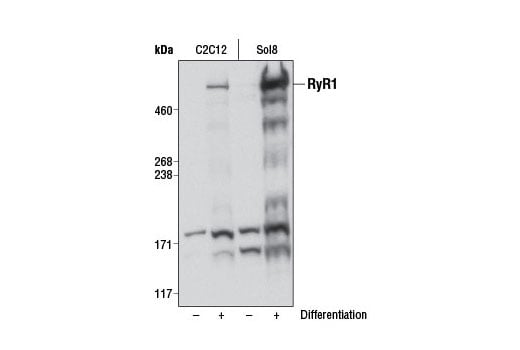
Western Blotting 1:1000
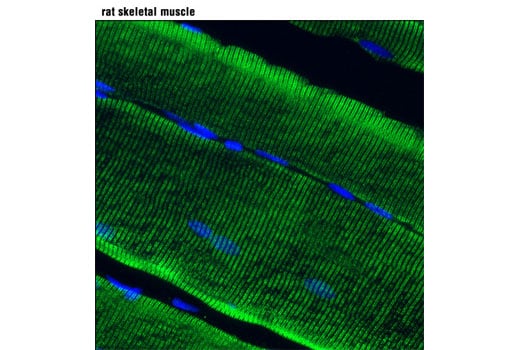
Immunofluorescence (Frozen) 1:100

Storage

Supplied in 10 mM sodium HEPES (pH 7.5), 150 mM NaCl, 100 µg/ml BSA, 50% glycerol and less than 0.02% sodium azide. Store at –20°C. Do not aliquot the antibody.

For a carrier free (BSA and azide free) version of this product see product #19443.

Specificity/Sensitivity

RyR1 (D4E1) Rabbit Monoclonal Antibody recognizes endogenous levels of total RyR1 protein. This antibody does not cross-react with other ryanodine receptor proteins.

Species predicted to react based on 100% sequence homology

Pig

Source / Purification

Monoclonal antibody is produced by immunizing animals with a synthetic peptide corresponding to residues surrounding Arg830 of human RyR1 protein.

Background

Ryanodine receptors (RyRs) are large (>500 kDa), intracellular calcium channels found in the sarcoplasmic/endoplasmic reticulum membrane and are responsible for the release of Ca2+ from intracellular stores in excitable cells, such as muscle and neurons. RyRs exist as three mammalian isoforms (RyR1-3), all of which form homotetramers regulated by phosphorylation and/or direct or indirect interaction with a variety of proteins (L-type calcium channels, PKA, FKBP12/12.6, CaMKII, calmodulin, calsequestrin, junctin, and triadin) and ions (Mg2+ and Ca2+). Regulation of the RyR channel by protein modulators occurs within the large cytoplasmic domain, whereas the carboxy-terminal portion of the protein forms the ion-binding and conducting pore (1,2). RyR1 and RyR2 are predominantly expressed in skeletal and cardiac muscle, respectively, where they localize exclusively to the sarcoplasmic reticulum (SR) and facilitate calcium-mediated communication between transverse-tubules and sarcoplasmic reticulum. Contraction of skeletal muscle is triggered by release of calcium ions from the SR following depolarization of T-tubules. Research studies have shown that defects in RyR1 are the cause of malignant hyperthermia susceptibility type 1 (MHS1), central core disease of muscle (CCD), multiminicore disease with external ophthalmoplegia, and congenital myopathy with fiber-type disproportion (CFTD), each of which is manifested by defects in muscle function, metabolism, and development (2). Investigators have shown that defects in RyR2 are the cause of familial arrhythmogenic right ventricular dysplasia type 2 (ARVD2) and catecholaminergic polymorphic ventricular tachycardia type 1 (CPVT1), both of which are implicated in sudden death syndromes as a result of electrical instability and degeneration of the ventricular myocardium or stress-induced ventricular tachycardia (2). Despite low levels of expression in skeletal and smooth muscle, RyR3 is the dominant isoform in neuronal cells (hippocampal neurons, thalamus, Purkinje cells) and has been implicated in synaptic plasticity, dendritic spine remodeling, and spatial memory formation (3). The role of RyR3 in neuronal function has been substantiated by mice lacking RyR3, which demonstrate normal motor function, but possess numerous behavioral and social defects (4).

Species Reactivity

Species reactivity is determined by testing in at least one approved application (e.g., western blot).

Western Blot Buffer

IMPORTANT: For western blots, incubate membrane with diluted primary antibody in 5% w/v BSA, 1X TBS, 0.1% Tween® 20 at 4°C with gentle shaking, overnight.

Applications Key

W: Western Blotting IF-F: Immunofluorescence (Frozen)

Cross-Reactivity Key

H: Human M: Mouse R: Rat

Trademarks and Patents

Cell Signaling Technology is a trademark of Cell Signaling Technology, Inc.

All other trademarks are the property of their respective owners. Visit cellsignal.com/trademarks for more information.

Limited Uses

Except as otherwise expressly agreed in a writing signed by a legally authorized representative of CST, the following terms apply to Products provided by CST, its affiliates or its distributors. Any Customer's terms and conditions that are in addition to, or different from, those contained herein, unless separately accepted in writing by a legally authorized representative of CST, are rejected and are of no force or effect.

Products are labeled with For Research Use Only or a similar labeling statement and have not been approved, cleared, or licensed by the FDA or other regulatory foreign or domestic entity, for any purpose. Customer shall not use any Product for any diagnostic or therapeutic purpose, or otherwise in any manner that conflicts with its labeling statement. Products sold or licensed by CST are provided for Customer as the end-user and solely for research and development uses. Any use of Product for diagnostic, prophylactic or therapeutic purposes, or any purchase of Product for resale (alone or as a component) or other commercial purpose, requires a separate license from CST. Customer shall (a) not sell, license, loan, donate or otherwise transfer or make available any Product to any third party, whether alone or in combination with other materials, or use the Products to manufacture any commercial products, (b) not copy, modify, reverse engineer, decompile, disassemble or otherwise attempt to discover the underlying structure or technology of the Products, or use the Products for the purpose of developing any products or services that would compete with CST products or services, (c) not alter or remove from the Products any trademarks, trade names, logos, patent or copyright notices or markings, (d) use the Products solely in accordance with CST Product Terms of Sale and any applicable documentation, and (e) comply with any license, terms of service or similar agreement with respect to any third party products or services used by Customer in connection with the Products.

Orders: 877-616-CELL (2355) [email protected] Support: 877-678-TECH (8324) [email protected] Web: cellsignal.com
For Research Use Only. Not for Use in Diagnostic Procedures.

Revision 4

Cell Signaling Technology Logo
Western blot analysis of extracts from C2C12 and Sol8 cells, undifferentiated (-) or differentiated (+), using RyR1 (D4E1) Rabbit mAb.
Western Blotting Image 1: RyR1 (D4E1) Rabbit Monoclonal Antibody
Confocal immunofluorescent analysis of rat skeletal muscle using RyR1 (D4E1) Rabbit mAb (green). Blue pseudocolor = DRAQ5® #4084 (fluorescent DNA dye).
Immunofluorescence Image 1: RyR1 (D4E1) Rabbit Monoclonal Antibody
Orders: 877-616-CELL (2355) [email protected] Support: 877-678-TECH (8324) [email protected] Web: cellsignal.com
For Research Use Only. Not for Use in Diagnostic Procedures.